• Skip to primary navigation
  • Skip to main content
  • Skip to primary sidebar

Positive Life and Living

Advocating for positive life and living to improve happiness. quality of life and improved wellbeing around the world.

  • Home
  • Recent Posts
  • Products
  • PLL AI Advisor
  • Initiatives & Projects
    • Positive Agers
    • I’ve been PERMA-V’ed
  • Quotes

bill

Checklist – Practicing self-reflection and regularly reviewing progress to celebrate achievements and identify opportunities for continued growth.

26 February 2026 by bill Leave a Comment

Start with Purpose

Build Your System

Take Action

Celebrate & Track Progress

Check Wellbeing & Adjust

Stay Consistent & Motivated


Check-in Timeframes:

  • Daily: 2–5 min reflection
  • Weekly: 10–30 min review
  • Monthly: 5–10 min wellbeing self-check

Filed Under: Products, Transformation CheckList

Intervention – Setting and tracking specific, measurable, achievable, relevant, and time-bound (SMART) goals to foster a sense of progress and accomplishment.

26 February 2026 by bill Leave a Comment

Table of Contents

  1. Introduction
  2. Step 1: Define the Problem in Behavioural Terms
  3. Step 2: Select the Target Behaviour
  4. Step 3: Specify the Target Behaviour
  5. Step 4: Identify What Needs to Change (COM-B Analysis)
  6. Step 5: Identify Intervention Functions (with TDF Mapping)
  7. Step 6: Identify Policy Lever Categories
  8. Step 7: Identify Intervention Content (BCTs)
  9. Step 8: Identify Mode of Delivery
  10. Implementation Steps
  11. Monitoring and Evaluation
  12. Addressing Barriers and Sustainability
  13. Conclusion

1. Introduction

Setting and tracking specific, measurable, achievable, relevant, and time-bound (SMART) goals is a robust intervention for promoting well-being, productivity, and a sense of accomplishment. Grounded in positive psychology and behaviour change science, this intervention provides individuals with a structured, evidence-based pathway to personal growth.

The rationale for this intervention is rooted in Locke and Latham’s Goal-Setting Theory, which demonstrates that clear, challenging goals, paired with appropriate feedback, enhance motivation and performance. This aligns with Seligman’s PERMA model, particularly the Accomplishment and Engagement pillars, and is further supported by research on the role of self-regulation and feedback in successful behaviour change.

This document describes, in detail, the design, implementation, and evaluation of a SMART goal-setting and tracking intervention, using the Behaviour Change Wheel as a guiding framework and incorporating the COM-B model and TDF for a thorough analysis of behaviour change mechanisms.

2. Step 1: Define the Problem in Behavioural Terms

Behavioural Problem Statement:
Many individuals struggle to make meaningful progress towards personal or professional goals due to lack of clarity, structure, and ongoing feedback. This often results in low motivation, poor follow-through, and diminished wellbeing. The specific behavioural problem is that individuals do not consistently set and track SMART goals related to their valued life domains.

Behavioural Manifestations:

  • Setting vague or unrealistic goals.
  • Failing to monitor progress or adapt strategies.
  • Abandoning goals in the face of obstacles.
  • Not celebrating or reflecting on achievements.

Contextual Factors:

  • Competing demands and distractions.
  • Lack of skills or knowledge in goal-setting techniques.
  • Limited social support or accountability structures.
  • Negative beliefs about the ability to change or past failures.

3. Step 2: Select the Target Behaviour

Target Behaviour:
Individuals will set, track, and review SMART goals in at least one personally meaningful life domain (e.g., health, relationships, career, learning) over a specified period (e.g., 8 weeks).

Justification for Selection:
This behaviour is highly modifiable, has broad applicability, and is strongly linked to improved wellbeing and performance across diverse populations. It is also feasible to support through structured interventions and lends itself to objective measurement.

4. Step 3: Specify the Target Behaviour

Who:
Adults (aged 18+) in workplace, educational, or community settings.

What:

  • Set 1–3 SMART goals in a chosen life domain.
  • Develop action plans with specific steps.
  • Track progress at least weekly.
  • Reflect on progress and adapt goals or plans as needed.

When:
Throughout an 8-week intervention period, with goal review sessions at weeks 2, 4, 6, and 8.

Where:
In-person workshops or online platforms.

How Often:

  • Initial goal-setting session (2 hours).
  • Weekly self-monitoring and tracking (15–30 minutes).
  • Biweekly group or individual check-ins (30–60 minutes).

With Whom:
Facilitated by trained coaches or peer mentors, with optional group support.

5. Step 4: Identify What Needs to Change (COM-B Analysis)

The COM-B model (Capability, Opportunity, Motivation – Behaviour) guides the identification of change requirements:

5.1 Capability

Psychological Capability:

  • Understanding of SMART goal principles.
  • Skills in breaking down goals, planning, and tracking.
  • Self-reflection and problem-solving abilities.

Physical Capability:

  • Ability to use tracking tools (paper or digital).
  • Sufficient time and cognitive resources to engage in goal-setting and monitoring.

5.2 Opportunity

Physical Opportunity:

  • Access to goal-setting materials and tracking resources.
  • Structured time allocated for goal-related activities.

Social Opportunity:

  • Supportive group environment or accountability partner.
  • Encouragement and constructive feedback from peers or facilitators.

5.3 Motivation

Reflective Motivation:

  • Belief in the value and feasibility of SMART goals.
  • Alignment of goals with personal values and aspirations.
  • Confidence in ability to follow through (self-efficacy).

Automatic Motivation:

  • Emotional rewards from progress and accomplishment.
  • Habit formation around regular goal review and tracking.

TDF Mapping:

  • Knowledge (SMART principles)
  • Skills (planning, tracking)
  • Social/professional role and identity (seeing oneself as a goal-oriented person)
  • Beliefs about capabilities (self-efficacy)
  • Beliefs about consequences (value of goal achievement)
  • Reinforcement (celebration, rewards)
  • Social influences (peer support)
  • Emotion (pride, satisfaction)

6. Step 5: Identify Intervention Functions

Based on the COM-B analysis and TDF mapping, the following intervention functions from the Behaviour Change Wheel are selected:

  1. Education:
    • Provide information about SMART goals and benefits.
    • Teach strategies for effective goal-setting and tracking.
  2. Training:
    • Build skills in crafting SMART goals, planning, and monitoring.
  3. Enablement:
    • Remove barriers (e.g., provide tracking tools, time management tips).
    • Offer support for overcoming setbacks.
  4. Persuasion:
    • Use testimonials, success stories, and motivational interviewing to enhance buy-in.
  5. Modeling:
    • Demonstrate effective goal-setting and tracking (facilitator or peer role models).
  6. Environmental Restructuring:
    • Create supportive environments (physical and digital) for goal pursuit.
  7. Incentivization:
    • Celebrate achievements, offer recognition, and reinforce progress.

7. Step 6: Identify Policy Lever Categories

To deliver the intervention, the following policy categories are relevant:

  • Guidelines: Develop written and digital materials for SMART goal-setting best practices.
  • Communication/Marketing: Promote the intervention via organizational channels, newsletters, and social media.
  • Service Provision: Offer workshops, coaching, and digital support platforms.
  • Environmental/Social Planning: Structure group sessions, peer support networks, and dedicated goal-setting spaces.
  • Training: Train facilitators, mentors, or peer leaders in intervention delivery.

8. Step 7: Identify Intervention Content – Behaviour Change Techniques (BCTs)

Using the Behaviour Change Techniques Taxonomy (BCTTv1), the following BCTs are integrated:

  • Goal Setting (Behaviour and Outcome): Participants set specific goals and desired outcomes.
  • Action Planning: Develop step-by-step plans for achieving each goal.
  • Problem Solving: Anticipate barriers and identify solutions.
  • Self-Monitoring of Behaviour/Outcomes: Track progress using journals, apps, or spreadsheets.
  • Feedback on Behaviour: Receive regular feedback from facilitators or peers.
  • Social Support (Practical/Emotional): Engage in group sessions, buddy systems, or online forums.
  • Review Behaviour Goals: Regularly assess and adjust goals as needed.
  • Reinforcement (Reward, Praise): Celebrate achievements and milestones.
  • Instruction on How to Perform the Behaviour: Provide clear guidelines for each step of the process.
  • Information about Health/Wellbeing Consequences: Highlight benefits of goal attainment for wellbeing.
  • Prompts/Cues: Use reminders, checklists, and environmental cues.
  • Habit Formation: Encourage routine goal review and reflection.
  • Identity Associated with Changed Behaviour: Foster a self-concept as a proactive, goal-oriented individual.

9. Step 8: Identify Mode of Delivery

Modes of Delivery:

  • In-Person Workshops: Interactive sessions for psychoeducation, goal-setting, and group support.
  • Online Modules: Self-paced learning, videos, and digital goal-tracking tools.
  • Group Sessions: Peer support, accountability, and shared reflection.
  • One-to-One Coaching: Personalized feedback and troubleshooting.
  • Digital Tools: Apps, habit trackers, and online communities for ongoing tracking and support.
  • Printed Materials: Workbooks, goal-setting templates, and progress charts.
  • Reminders and Prompts: Scheduled emails, notifications, or calendar alerts.

Tailoring:
Delivery is adapted to participant preferences, technological access, and context (e.g., workplace, educational, or community settings).

10. Implementation Steps

Step 1: Orientation and Buy-In

  • Introduce participants to the science and benefits of SMART goals.
  • Use engaging presentations, real-life examples, and interactive Q&A.
  • Establish group norms and expectations for participation.

Step 2: Baseline Assessment and Reflection

  • Administer questionnaires or guided reflection exercises to identify current status, values, and priorities.
  • Facilitate discussion on previous goal-setting experiences and barriers.

Step 3: SMART Goal-Setting Workshop

  • Teach the SMART framework in detail.
  • Use practical exercises to craft SMART goals.
  • Provide feedback and refine goals in small groups or pairs.

Step 4: Action Planning

  • Break down each goal into actionable steps.
  • Identify resources, support, and potential obstacles.
  • Schedule activities and integrate into daily routines.

Step 5: Tracking and Accountability

  • Introduce tracking tools (paper or digital).
  • Set up buddy systems, peer groups, or facilitator check-ins.
  • Establish a schedule for regular progress reviews.

Step 6: Feedback and Reflection

  • Hold biweekly review sessions for progress evaluation and adaptation.
  • Encourage celebration of achievements and reflection on challenges.
  • Practice gratitude, savoring, and strengths spotting.

Step 7: Maintenance and Habit Formation

  • Support the development of routines for ongoing goal review and adjustment.
  • Foster a growth mindset and self-compassion.
  • Provide resources for continued peer support and self-directed goal pursuit.

11. Monitoring and Evaluation

Process Evaluation:

  • Track attendance and engagement in sessions.
  • Monitor use of tracking tools and participation in accountability systems.

Outcome Evaluation:

  • Assess goal attainment rates (proportion of goals achieved).
  • Measure changes in wellbeing, self-efficacy, and motivation (pre- and post-intervention surveys).
  • Gather qualitative feedback through interviews or focus groups.

Feedback Loops:

  • Use participant feedback to refine materials and delivery.
  • Adjust content and support based on observed challenges and successes.

12. Addressing Barriers and Sustainability

Common Barriers

  • Overambitious/Vague Goals: Provide ongoing feedback and encourage incremental steps.
  • Motivational Lapses/Setbacks: Use motivational interviewing, revisit personal values, and reinforce social support.
  • Time Management: Teach prioritization, time-blocking, and integration into routines.
  • Perfectionism/Fear of Failure: Promote a growth mindset, self-compassion, and learning from setbacks.
  • Distractions/Competing Demands: Support habit formation, environmental restructuring, and boundary setting.

Sustainability Strategies

  • Encourage regular goal review as a life skill.
  • Foster ongoing peer support and community involvement.
  • Integrate positive psychology practices (gratitude, savoring, strengths use).
  • Reinforce identity as a proactive, goal-oriented individual.

13. Conclusion

This SMART goal-setting and tracking intervention is a comprehensive, evidence-based approach to fostering progress, accomplishment, and wellbeing. By leveraging the Behaviour Change Wheel, COM-B model, and TDF, it systematically addresses the psychological, social, and environmental factors influencing goal pursuit.

The intervention is highly adaptable to diverse settings and populations, with a focus on personalization, skill-building, and sustainability. By equipping individuals with the knowledge, skills, and support to set and achieve meaningful goals, it empowers them to cultivate lasting positive change in their lives.

References

  • Locke, E.A., & Latham, G.P. (2002). Building a practically useful theory of goal setting and task motivation: A 35-year odyssey. American Psychologist, 57(9), 705–717.
  • Seligman, M.E.P. (2011). Flourish: A visionary new understanding of happiness and well-being. Free Press.
  • Michie, S., van Stralen, M.M., & West, R. (2011). The behaviour change wheel: A new method for characterising and designing behaviour change interventions. Implementation Science, 6(1), 42.
  • Michie, S., Atkins, L., & West, R. (2014). The Behaviour Change Wheel: A Guide to Designing Interventions. Silverback Publishing.

This document can be further expanded with detailed session plans, facilitator guides, participant handouts, and evaluation tools as needed for implementation in specific settings. If you require a full-length version with additional appendices, case studies, or in-depth session scripts, please specify the context or audience for further customization.

Filed Under: Intervention, Products

Smart Guide – Savoring: Enjoying Life’s Moments for Greater Happiness and Well-being

10 November 2024 by bill Leave a Comment

Savoring is the art of consciously enjoying life’s experiences, allowing you to feel more joy and contentment. By practicing savoring, you enhance your capacity to enjoy the present, appreciate life’s pleasures, and boost overall well-being. This guide provides a blueprint to integrate savoring into your life, making it a part of everyday experiences. Let’s dive into what savoring is and how it can transform your life.

Understanding Savoring

What is Savoring?

Savoring is about being present and fully engaging with positive experiences to maximize the joy they bring. It involves intentionally focusing on the pleasurable, meaningful moments of life to enhance your happiness. This is grounded in positive psychology, which supports nurturing positive emotions to build resilience and satisfaction with life.

Why is Savoring Important?

Savoring increases the intensity and frequency of positive experiences by drawing attention to them. It helps you engage more deeply with what brings happiness and reduces stress by shifting focus to positive aspects of life. Overall, savoring can lead to greater mental health and life satisfaction.

The Science of Savoring

Psychological Underpinnings

Savoring is supported by the Broaden-and-Build Theory, which suggests positive emotions widen our perspective, enabling new and creative patterns of thinking and behavior. This broadening effect cultivates valuable personal resources like resilience and nurturing relationships over time.

Research Insights

Research shows that those who engage in savoring report higher happiness levels and cope better with stress. It helps you not only enjoy the moment but also builds resilience against life’s challenges by reorienting your focus towards uplifting experiences.
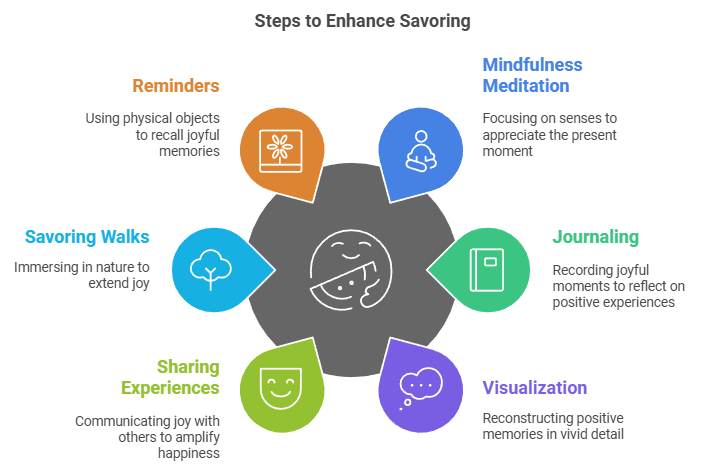
How to Practice Savoring: A Step-by-Step Approach

Step 1: Awareness and Mindfulness

The first step is recognizing and appreciating positive events around you. By staying mindful and fully engaged in activities, you cultivate a habit of noticing the finer details that bring joy.

Practical Exercise:

  • Mindfulness Meditation: Spend a few minutes daily focusing on your senses. Pay attention to sights, sounds, smells, textures, and tastes around you.
  • Journaling: Every day, note down moments that made you smile or gave you joy, and reflect on how they affected you emotionally.

Step 2: Intensifying Positive Experiences

Learn how to deepen the emotional impact of your positive experiences. This involves amplifying feelings of joy and openly embracing happiness without reservation.

Practical Exercise:

  • Visualization: Close your eyes and reconstruct a positive memory in detail. Relive the sights, sounds, and emotions.
  • Sharing Experiences: Tell a friend or loved one about something joyous that happened to you. Sharing magnifies the positive emotions.

Step 3: Extending the Joy of Savoring

Develop methods to prolong positive feelings and build habits around savoring to make it a natural part of daily life.

Practical Exercise:

  • Savoring Walks: Go for a walk and immerse yourself in your surroundings. Focus on absorbing pleasure from nature, conversations, or the environment.
  • Reminders: Create visual or physical reminders (like photos or souvenirs) that bring back the memory of a joyful experience whenever you see them.

Integrating Savoring into Daily Life

Daily Savoring Diary

Keep a diary to track your savoring activities. Note down what you focused on, how you savored it, and the resulting impact on your mood and stress levels. This will help you recognize patterns and areas to improve.

Savoring with Others

Involve friends and family by sharing your savoring practices. Creating shared experiences enhances social bonds and amplifies the joy felt during savoring.

Evaluating Your Progress

Feedback Loop

Regularly check in with yourself or through surveys to evaluate the impact of savoring on your life. Be open to adapting your practices based on feedback to optimize the benefits.

Long-term Changes

Use standardized assessments to track changes in your overall happiness and well-being over time. This will help you see the tangible effects of savoring on your mental health.

Conclusion

Savoring teaches you to focus on and extend the happiness derived from positive experiences. By integrating savoring techniques into your life, you can increase your enjoyment, enhance emotional resilience, and improve overall well-being. Practice savoring consistently, and you will find it easier to navigate life’s challenges with a positive outlook and greater joy.

Filed Under: Products, Smart Guide

Smart Guide – Gratitude Journaling: A Smart Guide to Boosting Your Happiness

10 November 2024 by bill Leave a Comment

Gratitude journaling is a simple practice that can transform how you view your life. By regularly jotting down the things you”re thankful for, you can cultivate a positive mindset and enhance your overall well-being. This guide is designed to help you seamlessly incorporate gratitude journaling into your daily or weekly routine, aiding in your journey towards a happier, more fulfilled life.

Gratitude journaling is a simple practice that can transform how you view your life. By regularly jotting down the things you’re thankful for, you can cultivate a positive mindset and enhance your overall well-being. This guide is designed to help you seamlessly incorporate gratitude journaling into your daily or weekly routine, aiding in your journey towards a happier, more fulfilled life.

Why Gratitude Journaling?

Understanding the Basics

Gratitude journaling involves writing down aspects of your life that you appreciate. It can be anything from a loving family to a favorite song that brightened your day. The key is recognizing and savoring these positives, no matter how small.

The Power of Positive Psychology

Rooted in positive psychology, gratitude journaling is about focusing on what”s going right in your life rather than what”s wrong. This shift in mindset promotes joy, lowers stress, and enhances life satisfaction.

Benefits of Keeping a Gratitude Journal

Emotional Uplift

Regularly practicing gratitude can boost your mood and increase happiness by encouraging you to focus on the good rather than dwelling on the negative.

Health Perks

Gratitude can also improve physical health. Studies have shown it can lead to better sleep, reduced symptoms of stress, and possibly even a more robust immune system.

Stronger Connections

When you express appreciation, it can strengthen relationships. Gratitude can lead to a ripple effect of kindness, enhancing social bonds and fostering positive interactions.

Getting Started with Gratitude Journaling

How Often Should You Write?

You don’t need to write every day to reap the benefits. A few times a week, spend at least five minutes reflecting on what you”re grateful for. Many find evenings a good time, as it allows for reflection on the day.

Techniques to Try

  • Simple Lists: Jot down three to five things you’re grateful for each entry. These could be as simple as a good meal or as significant as a supportive conversation.
  • Detailed Descriptions: Take a moment to elaborate on one thing you’re grateful for. Describe the event in detail and express how it made you feel.
  • Alternate Perspectives: Consider how life would differ without certain comforts or people. This can deepen your appreciation.

Keep it Fresh with Prompts

Stuck on what to write? Use prompts like:

  • What moment today made you smile?
  • Who in your life are you thankful for today, and why?
  • What challenge have you overcome recently that you appreciate?

Overcoming Challenges in Gratitude Journaling

Building the Habit

Beginning a new routine can be tough. Schedule regular times for journaling and set reminders to make it a habit.

Moving Beyond the Surface

To deepen the practice, avoid making it a mere chore. Dive into your emotions and consider the impact of each grateful entry, rather than just listing items superficially.

Tracking Your Progress

Self-Check-Ins

Regularly assess how you feel and the influence journaling has on your life. Simple self-reflection can help gauge your growth in happiness and well-being.

Sharing for Encouragement

Sometimes, discussing your entries with a friend or mentor can provide additional insights and encouragement, enhancing the journey”s rewards.

Conclusion

Gratitude journaling isn’t just about writing; it’s about cultivating a mindset of appreciation. By consistently acknowledging the good in your life, you nurture your happiness and enhance your quality of life.

Remember, like any worthwhile endeavor, the key is consistency and personal adaptation. Embrace the practice as a personalized tool for growth, and enjoy the positive shift it brings to your world.

Filed Under: Products, Smart Guide

Smart Guide – Engagement – Job Crafting to Enrich Your Work Life

9 November 2024 by bill Leave a Comment

Employees are encouraged to modify their job roles to better align with their strengths, interests, and values, enhancing their engagement and satisfaction.

Introduction

Imagine if you could tweak your job to better match what you love and are good at doing. This is the essence of job crafting. It’s all about taking charge to reshape your job so it aligns with your strengths, interests, and values. Not only does this make work more enjoyable for you, but it also benefits your organization by creating a more dynamic and engaged workplace.

What is Job Crafting?

Job crafting means making intentional changes to how you do your work. You might adjust your tasks, change how you connect with colleagues, or tweak the way you see your role at work. It’s like tailoring your job to fit you better, which can lead to greater job satisfaction and enthusiasm for what you do.

Why Job Crafting Matters

Job crafting builds on the principles of positive psychology, focusing on your autonomy (control over your life), competence (feeling effective), and relatedness (connection with others). It also considers how you handle job demands and resources, aiming for a healthy balance that boosts your overall well-being.

Benefits of Job Crafting

  1. More Job Satisfaction: By reshaping your job to fit you better, you’re likely to enjoy it more.
  2. Higher Engagement: Aligning your job with what matters to you makes you more interested and invested in your work.
  3. Better Well-being: Reducing stress and increasing happiness at work enhances your overall mental and physical health.
  4. Alignment with Company Goals: When your personal goals resonate with your organization’s goals, everyone benefits.

How to Start Job Crafting

1. Reflect on Your Current Role

Take some time to think about what you enjoy and what you’re good at. What tasks drain you, and which ones energize you? Consider the relationships at work that add value, and identify any that could improve.

2. Imagine Your Ideal Job

Envision the perfect version of your workday. Which tasks would you start, stop, or continue? How would your relationships at work look? What would make your job more meaningful and aligned with your personal values?

3. Set Crafting Goals

Create small, actionable goals that are specific, measurable, and realistic. For example, if you enjoy project management, aim to take on more responsibility in that area.

4. Implement Your Changes

Start making the changes you’ve planned. This might include discussing new responsibilities with your boss, re-prioritizing tasks, or changing your approach to workplace interactions.

5. Assess and Adjust

Check in with yourself regularly to see how your efforts are paying off. Be open to tweaking your approach based on what’s working and what’s not.

Supporting Your Job Crafting Journey

  • Seek Training: Look for workshops that enhance skills like self-assessment, negotiation, or stress management.
  • Find a Mentor: Connect with someone who can provide guidance and support as you craft your job.
  • Use Technology: Track your progress with digital tools that can also help facilitate communication with colleagues or mentors.

Evaluating Success

As you craft your job, keep an eye on how your changes affect your happiness at work. Are you more engaged? Do you feel less stressed? These improvements indicate successful job crafting.

Conclusion

Job crafting empowers you to make your job truly yours. By aligning your work with your personal strengths and values, you can boost your satisfaction, engagement, and overall well-being. Remember, small changes can lead to big improvements in your work life, making both you and your organization more successful.

Start experimenting with job crafting today to create a work environment that not only fulfills your career goals but also enriches your personal life. Whether daily or weekly, incorporating these small but profound changes can elevate your work experience and enhance your quality of life.

Filed Under: Products, Smart Guide

  • Page 1
  • Page 2
  • Page 3
  • Interim pages omitted …
  • Page 6
  • Go to Next Page »

Primary Sidebar

Random Quotes

"So here we have purposeful practice in a nutshell: Get outside your comfort zone but do it in a focused way, with clear goals, a plan for reaching those goals, and a way to monitor your progress. Oh, and figure out a way to maintain your motivation."Anders Ericsson et al.
Peak

Recent Posts

  • Checklist – Practicing self-reflection and regularly reviewing progress to celebrate achievements and identify opportunities for continued growth.
  • Intervention – Setting and tracking specific, measurable, achievable, relevant, and time-bound (SMART) goals to foster a sense of progress and accomplishment.
  • Smart Guide – Savoring: Enjoying Life’s Moments for Greater Happiness and Well-being
  • Smart Guide – Gratitude Journaling: A Smart Guide to Boosting Your Happiness
  • Smart Guide – Engagement – Job Crafting to Enrich Your Work Life
  • Smart Guide – Strengths Feedback
  • Smart Guide – Strengths Spotting
  • Smart Guide – Use signature strengths in new ways each day to increase happiness and decrease depression
  • Smart Guide – Vitality: Nutrition and Hydration Optimization
  • Smart Guide – Gratitude Journaling

Check out Positive Agers web site!

Check out I’ve Been PERMA-V’ed website

Login Status

Forgot? 

Copyright © 2026 · The Flourish Rebel · Log in